
RV park web design & digital marketing
Boost your park's online presence and drive more direct bookings. Affordable, proven web design and digital marketing tailored to RV parks, resorts, and campgrounds.

RV parks and resorts live and die by bookings, and every booking that comes through your own website instead of a third-party platform keeps more money in your pocket. We build park websites and run the marketing that fills more sites, more nights, with fewer commissions paid out.
We've built and host sites for parks and resorts, so we know what travelers want before they book: clear rates and amenities, real photos, easy availability and booking, and a site that loads fast on the phone they're planning the trip on. We make that experience effortless, then drive qualified traffic to it.
What those numbers actually mean
Most marketing pages show you a logo wall. Here is the number that matters instead, taken from a park we build for and host: 86% of its traffic from Google comes from people who were not searching for the park by name.
That is the whole job. Guests who already know your park will find you regardless, they type your name in and arrive. The growth is in the other group, the traveler routing through West Texas who searches for a park in the town they are passing through and has never heard of you. Being the park they find is worth more than any brochure.
Over sixteen months that one site drew 3,122 visits from search, and it holds page-one positions across a set of non-branded local searches, the kind that name a town rather than a business. Those are the searches that reach people who do not yet know you exist. A second park site we run adds another 808 visits over the same window and ranks first for its own name.
Source: Google Search Console clicks and impressions for two client sites we build for and host, covering 2025-05-06 to 2026-08-26. These measure how many people found and visited the sites from search. They are not booking or revenue figures, and we won't quote you a number we can't show you the source for.
The searches that fill a park
Travelers don't plan a stop the way an owner imagines. They search from the cab of a truck a state away, on a phone with two bars, and they decide in under a minute. Across the park sites we run, the searches that bring people in fall into four groups.
Place-based
Searches that name a town or a stretch of highway rather than a business. The largest group by far, and the one that decides whether a traveler routing through your region ever learns you exist. These are the searches a park either owns or loses.
Near me
Proximity searches from someone already on the road who needs a spot tonight. Ready to book, low patience, and phone-first, so load speed and a visible phone number decide it.
Stay-type
Searches for long-term, monthly, or covered stays. These fill your slow months. Oilfield and travel-nurse work brings long-stay demand to West Texas year round, and a long-stay guest is worth many single nights.
Amenity and rig
Qualifying searches about hookups and amp service, pull-through access, rig length limits, and pet policy. Answer them plainly and you get the booking; leave them vague and the traveler assumes the answer is no and moves on.
What an RV park site has to get right
A park website has a shorter job than most. It has to answer six questions before a tired driver loses patience, and most park sites answer two of them.
- What does a night cost? Publish rates. Hiding them to force a phone call loses more bookings than it creates.
- Do you have room? Availability, or at minimum a fast way to ask that gets answered the same day.
- Will my rig fit? Length limits, pull-through versus back-in, hookup amps, and whether big rigs are welcome.
- What is actually there? Real photographs of your park, not stock images of a lake in Oregon.
- Where exactly is it? A map, the highway you're off, and the drive time to whatever brought them here.
- Can I book right now? On a phone, in under a minute, without creating an account.
We build all six into the page a traveler lands on, then make the site fast enough that they're still there to read it. Every park site we build is hosted, monitored, and maintained by us, so the speed and uptime hold after launch instead of decaying quietly.
The commission math
Listing platforms and booking marketplaces are useful. They're also expensive, and the cost compounds. A booking through your own site costs you nothing beyond the price of the site. The same booking through a marketplace costs a commission every single time, forever, including from guests who would have found you anyway.
We don't tell parks to abandon the listing sites. We tell them to stop paying a commission on the guests they could have owned. That means being findable for the place-based searches above, giving travelers a reason to book direct once they land, and making direct booking the easiest thing on the page. Every point of booking mix you move from marketplace to direct is margin you keep.
How we fill more sites
Booking-focused web design
A fast, mobile-first site that shows off your park, makes rates and amenities obvious, and turns browsers into direct bookings. We can connect your existing reservation system or keep it to a simple, fast enquiry, whichever matches how you actually take bookings.
Local & travel SEO
Getting you found for the searches above: the place-based and near-me terms travelers use, the long-stay searches that fill your slow season, and the regional events that spike demand. This is the work behind the 86% figure above.
Google Business Profile
The map result is often the first thing a traveler sees, and for proximity searches it's frequently the only thing. We optimize the profile, keep photos and amenities current, and build the review habit that decides who lands in the top three. See local SEO.
Hosting that holds up
Fast, secure hosting with nightly backups, uptime monitoring, and a real person in West Texas to call. A park site that's slow in July is losing bookings in your best month.
Park and resort sites we've built
Parks and resorts across Texas. We built these, we host them, and we still maintain them.


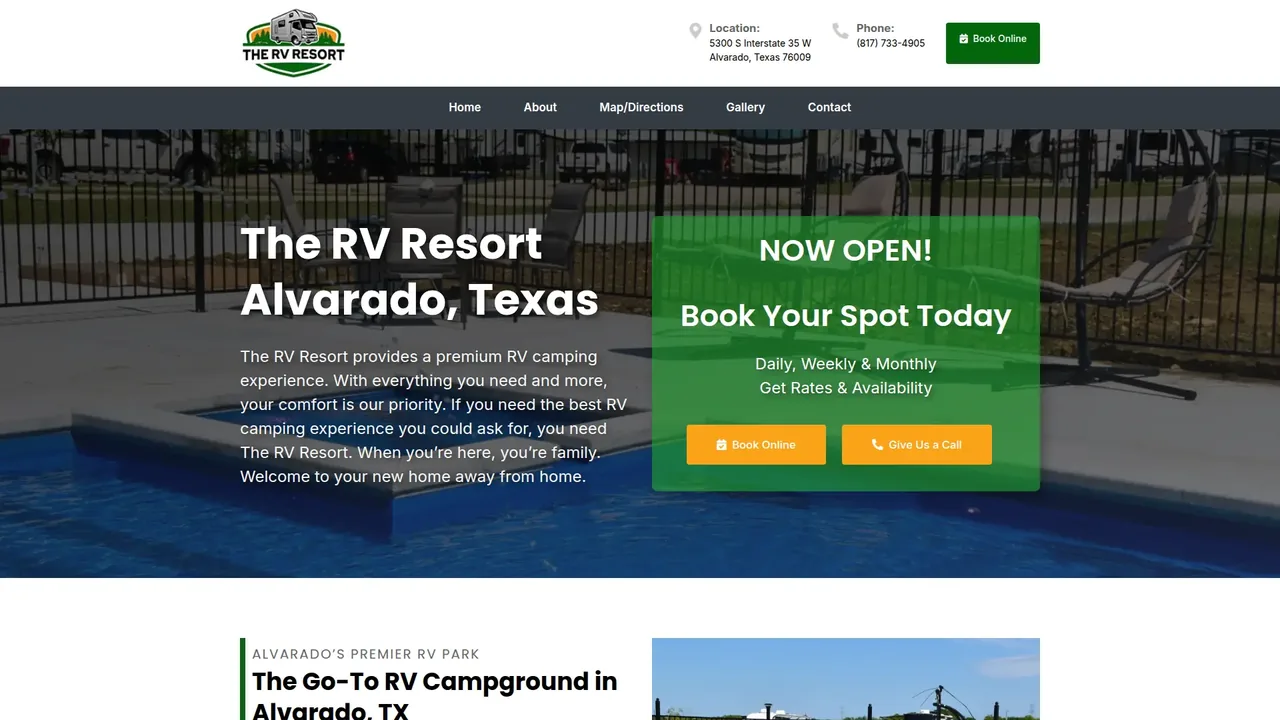
We build for RV and boat storage facilities too, including WT RV Storage in Midland — see the storage facility work if that's closer to your business, or the full portfolio.
RV park marketing questions
Still wondering about something? Call (432) 301-9327 or send a note, straight answers, no sales script.